
Artificial intelligence (AI)-powered precision agriculture tools can help growers better manage their orchards by reducing waste, increasing resilience and helping guide decisions about water use, fertilizer application and pest control, according to researchers at Penn State. However, the team said, not enough agricultural scientists are trained to develop and use these tools in real-world farming situations. An project underway in Penn State’s College of Agricultural Sciences aims to ease that shortage by training three doctoral degree students.
Growing winter wheat for both grain and straw production is common in poultry farms in the U.S. Mid-Atlantic region, where grain is used for feed and straw is used for animal bedding. Grain yield can be improved by spraying plants with a regulator that halts vertical growth and makes them less prone to falling over, a phenomenon farmers call “lodging” that can greatly reduce grain yields. A team of researchers at Penn State investigated the effect of a growth regulator on straw yield and quality.
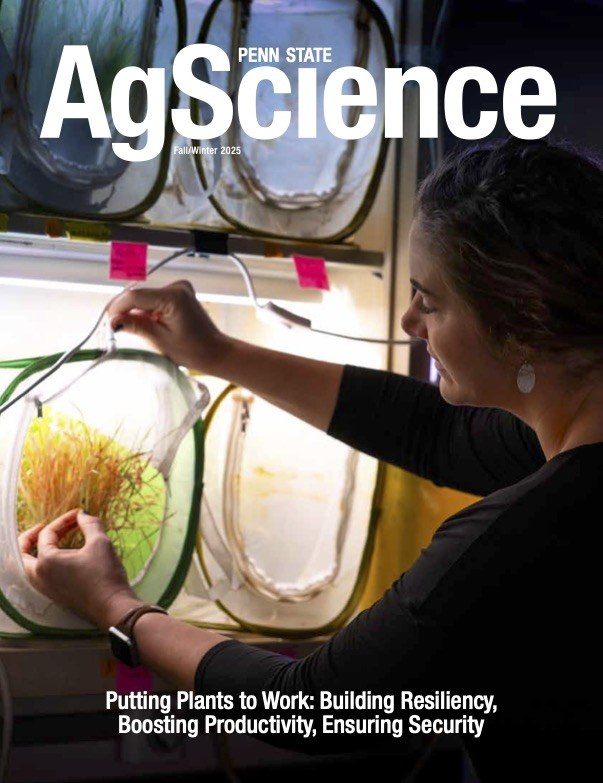
Penn State doctoral candidate Sahil Pawar studies how environmental stressors, primarily salty soil — a problem often overlooked in agriculture — affect the relationships between plants and insects.
Professor and Interim Department Head, Plant Science
Professor and Department Head, Ecosystem Science and Management
Professor and Department Head, Food Science
Professor and Department Head, Veterinary and Biomedical Sciences
Professor and Department Head, Animal Science
Professor and Department Head, Plant Pathology and Environmental Microbiology
Professor and Department Head, Agricultural and Biological Engineering
Professor and Department Head, Entomology
Professor and Department Head, Ag Economics, Sociology, and Education
Setting the tone and leading the charge in the College of Ag Sciences.
The Pennsylvania School for Excellence in the Agricultural Sciences, an affiliate of the National Conference of Governor's Schools, will be hosted by the College of Agricultural Sciences at the Penn State University Park Campus. Applications will open November 1, 2025.
PSEAS provides a broad overview of the diverse fields of agriculture and natural resources. Interested high school students and their parents should review this website to learn more about requirements and the application process.
